
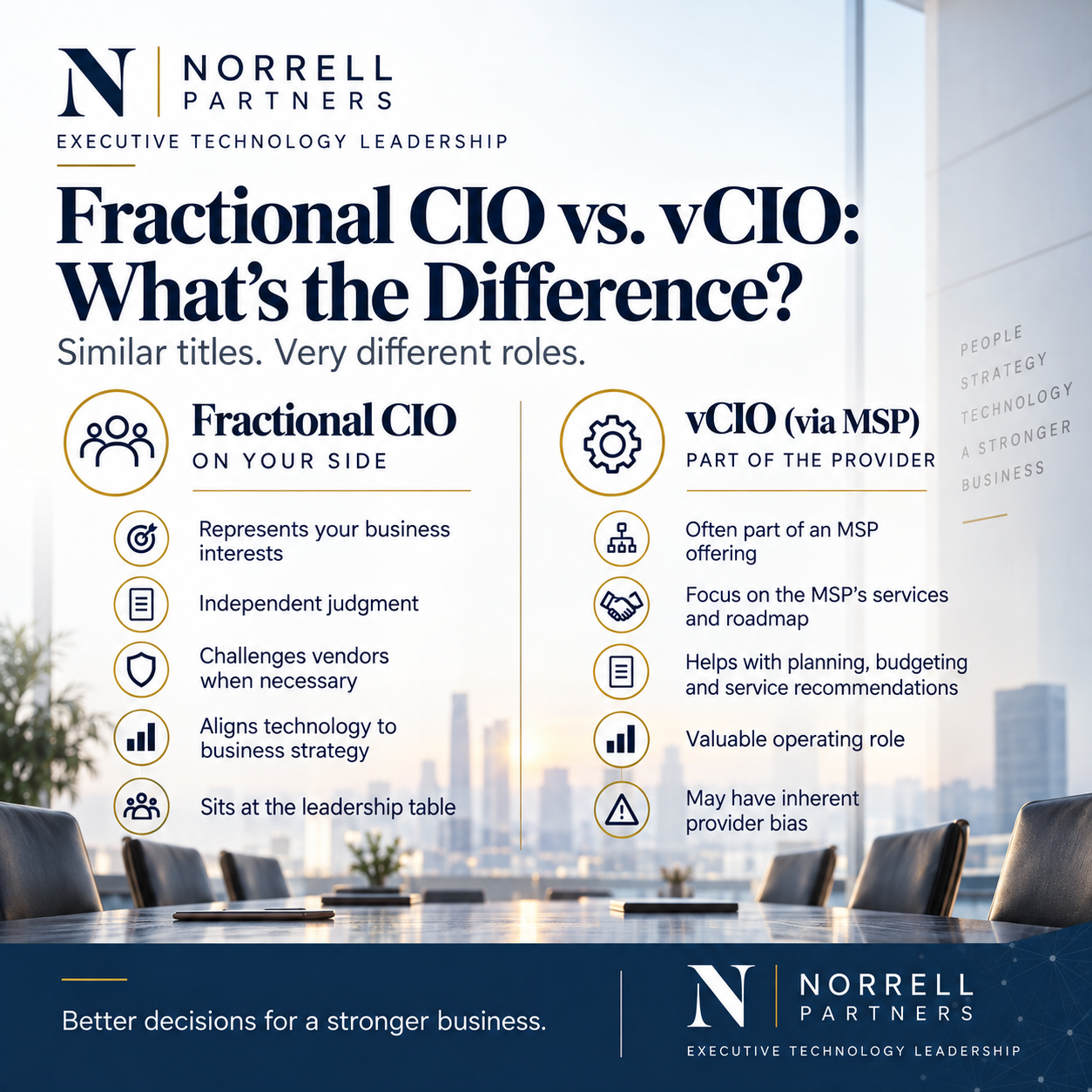
The titles sound similar, but the operating model may be very different
Fractional CIO and vCIO are often used interchangeably. That can make the buying decision more confusing than it needs to be.
The title itself is not the important part. The important questions are who the executive represents, what they are accountable for, how independent their recommendations are and whether they actually operate as part of the company’s leadership structure.
Many managed service providers offer a vCIO — a virtual CIO — as part of their service model. That can be useful. The vCIO may help with budgeting, technology planning, lifecycle management and translating the MSP’s technical work into a roadmap.
A Fractional CIO should generally occupy a different position: the company’s side of the table.
Start with incentives, not titles
There is no universal legal definition of “vCIO” or “Fractional CIO.” Some excellent independent executives use the vCIO title, and some MSP-affiliated vCIOs provide very strong strategic guidance.
That is why buyers should look past the label.
If the person recommending the technology is employed by the same organization that sells, implements or manages the technology, there is an inherent commercial relationship to understand. That does not mean the advice is bad. It does mean the buyer should know where the incentives sit.
An independent Fractional CIO is normally paid by the company for executive judgment and leadership rather than for selling a particular stack, implementation or recurring service.
That difference can matter when the right answer is to reduce spending, change providers, renegotiate a contract, consolidate tools or tell a vendor no.
What a good MSP vCIO can provide
A capable MSP wants the client to have a stable, secure and supportable technology environment. A vCIO function can help create structure around that goal.
Typical value may include:
- technology refresh and lifecycle planning;
- budget forecasting for infrastructure and managed services;
- reviewing support trends and recurring issues;
- security and platform recommendations;
- roadmap discussions tied to the MSP’s service portfolio; and
- coordination between the client and the technical delivery organization.
For many small businesses, that may be exactly the level of guidance needed.
The mistake is not using a vCIO. The mistake is assuming that every vCIO arrangement automatically provides the same scope, independence and executive accountability as a CIO sitting inside the company’s leadership team.
A Fractional CIO represents the business
The Fractional CIO’s starting point should be the business strategy, not the technology stack.
What is the company trying to accomplish? Where is growth coming from? Which risks matter? What is slowing the organization down? What investments deserve capital? Which capabilities should be internal? Which should be outsourced? What should the company stop doing?
The answers may lead to a particular platform or provider, but the decision should start with the business.
This also changes the CIO’s role with vendors. Rather than functioning as an extension of a service provider, the Fractional CIO can challenge proposals, compare alternatives, negotiate commercial terms, change providers when warranted and hold every vendor — including the MSP — accountable for outcomes.
The difference becomes clearer in difficult decisions
When everything is working, the distinction can appear academic.
It becomes much more important when the company faces a consequential decision.
Suppose the MSP recommends a major infrastructure upgrade. Who independently evaluates whether the architecture is right for the business?
Suppose cybersecurity spending is increasing. Who determines whether the additional controls materially reduce business risk?
Suppose an ERP replacement is being considered. Who connects that decision to operating processes, finance, data, integration, organizational capacity and business strategy?
Suppose the company is acquiring another business. Who owns the integration strategy across applications, identity, infrastructure, security, data and the technology organization?
Those are CIO questions because they require tradeoffs across the enterprise rather than expertise in one provider’s service offering.
Executive accountability is another dividing line
A CIO is not just a source of recommendations. The role should create ownership.
That means someone can answer the CEO, CFO or board when they ask:
- What are our top technology priorities?
- What are we spending and why?
- What are our material technology and cybersecurity risks?
- Which initiatives are on track?
- Where do we need an executive decision?
- What is the roadmap for the next 12 to 24 months?
- Who is accountable for execution?
A vCIO embedded in an MSP relationship may contribute to those answers. A Fractional CIO should own bringing the answers together on behalf of the business.
The best model is often Fractional CIO plus MSP
This does not need to be an either-or decision.
In fact, a strong Fractional CIO and a strong MSP can be an excellent combination for a growing company.
The MSP provides operational depth: help desk, infrastructure management, monitoring, security operations, cloud administration and technical specialists.
The CIO provides executive context: strategy, priorities, investment, risk, architecture, vendor governance and accountability.
When the roles are clear, the MSP can spend less time trying to infer business priorities and more time executing against an agreed direction. The CIO gains a capable delivery partner. The CEO gets fewer technology decisions pushed upward without context.
Seven questions to ask before choosing either model
The title on the proposal matters less than the answers to these questions:
- Who does this person ultimately represent? The business or the service provider?
- How are they compensated? Is their economic success connected to selling additional products or services?
- Can they recommend another provider? Would they be comfortable telling you to reduce, replace or rebid services?
- Do they participate in executive decisions? Can they work effectively with the CEO, CFO, board and operating leaders?
- What are they accountable for? Advice, or actual outcomes and follow-through?
- How broad is their remit? Do they address business systems, data, AI, cybersecurity, M&A, organization and investment — or primarily infrastructure and managed services?
- Will they challenge you as well as the vendors? A real executive partner must be willing to say no when the business case is weak.
When a vCIO may be enough
A company with relatively straightforward needs may not need a separate Fractional CIO.
If technology is stable, the MSP relationship is strong, major business systems are not changing, cybersecurity risk is well understood and there are few executive-level technology decisions, an MSP’s vCIO capability may provide sufficient planning and guidance.
That is an appropriate outcome. Executive structure should follow actual business need.
When independent CIO leadership becomes more valuable
The need changes when technology becomes more consequential to the business.
Common signals include rapid growth, acquisitions, ERP or CRM replacement, increasing cybersecurity exposure, AI initiatives, significant vendor spend, board scrutiny, a change of MSP, fragmented systems, weak data, or a CEO and CFO spending too much time resolving technology issues.
At that point, the business may need someone whose remit extends beyond keeping the technology environment healthy.
It needs an executive who can integrate strategy, risk, investment, people, vendors and execution into one coherent technology agenda.
The simplest distinction
A vCIO can be an excellent part of an MSP relationship. A Fractional CIO can be an excellent executive partner. The right choice depends on what the business actually needs.
If the primary requirement is planning and coordination around managed technology services, a vCIO may fit well.
If the requirement is independent executive judgment across the enterprise — including decisions that may challenge current vendors, technology investments or internal assumptions — the company is probably looking for CIO-level leadership.
The question is not which title sounds better. The question is who is sitting on your side of the table when the important decision has to be made.
If these issues are already affecting your business, learn how Norrell Partners Fractional CIO leadership can provide the executive ownership, independent judgment and accountability to move from decision to execution.
Frequently Asked Questions
Questions executives commonly ask
What is the difference between a vCIO and a Fractional CIO?
The terms are sometimes used interchangeably, but many vCIO roles are delivered as part of an MSP relationship, while a Fractional CIO typically operates as an independent executive on the client’s side of the table. Buyers should evaluate incentives, scope and accountability rather than relying on the title alone.
Is an MSP vCIO a bad thing?
No. A strong vCIO can provide useful planning, budgeting, lifecycle management and coordination. The key is understanding whether the company also needs independent executive leadership across business systems, risk, investment, vendors, AI, M&A and transformation.
Can a company use both a Fractional CIO and an MSP?
Yes. This is often an effective model. The MSP provides operational and technical delivery while the Fractional CIO provides business alignment, strategy, vendor governance, risk oversight and executive accountability.
How can I tell whether a technology advisor is truly independent?
Ask who employs and compensates the advisor, whether revenue is tied to products or services they recommend, whether they can recommend a competing provider, and what decisions or outcomes they are accountable for on behalf of the business.