
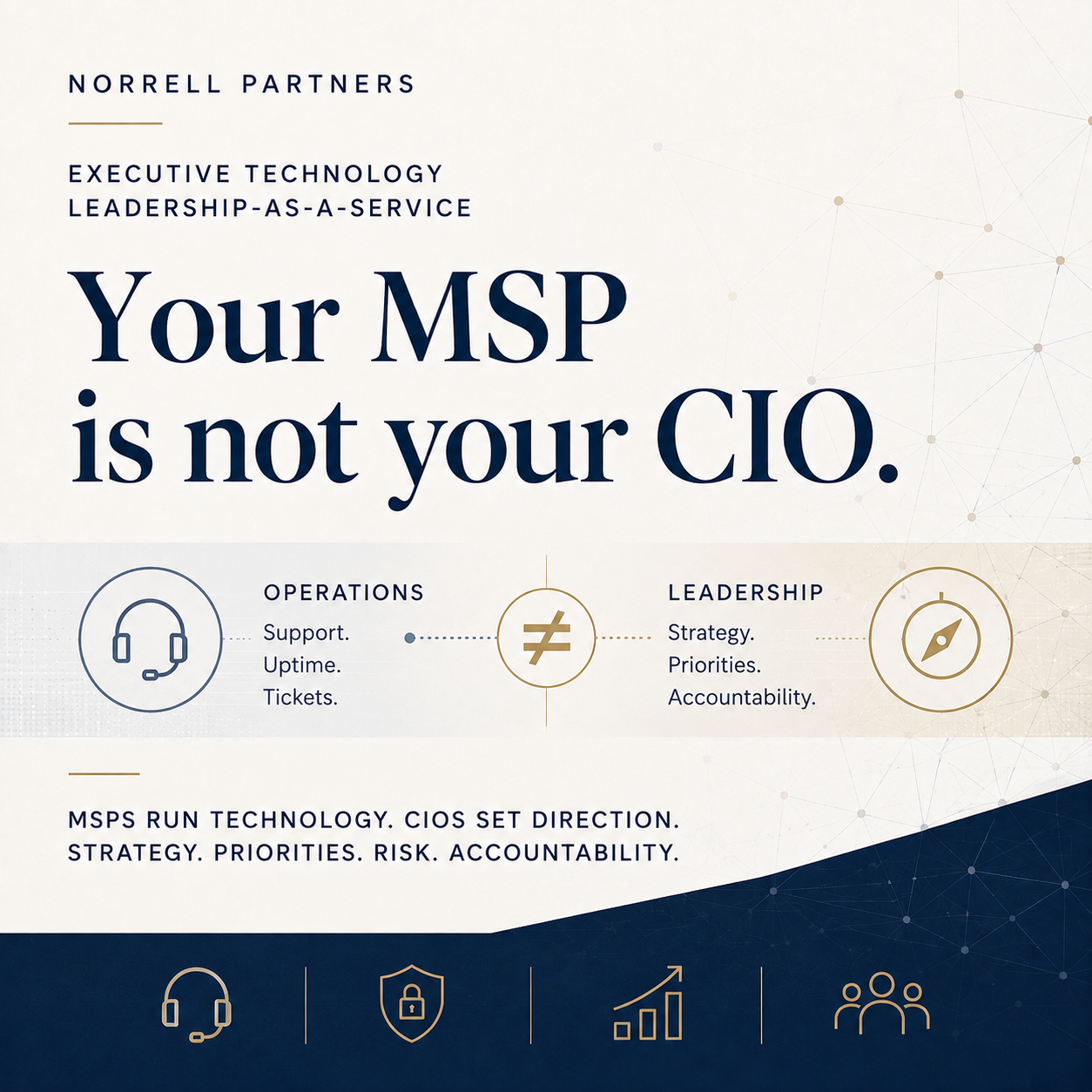
Running technology and leading technology are different jobs
A managed service provider can be an excellent partner for a growing company. MSPs commonly support users, manage devices and infrastructure, monitor systems, maintain backups and help operate the security environment.
Those responsibilities matter. Reliable technology operations are essential to the business.
But operating technology is not the same as owning technology strategy.
That distinction becomes increasingly important as the business grows, because technology decisions begin to affect capital allocation, cybersecurity risk, acquisitions, operating processes, AI adoption and the company's ability to scale.
The questions are different
An operational technology provider is appropriately focused on whether the environment is functioning well. A CIO has to look beyond today's environment and ask whether the company is building the right one for tomorrow.
Investment
Are we spending the right amount on the right technology, and what should we stop funding?
Architecture
Do our systems support where the business is going, or are they becoming constraints?
Risk
Where are we carrying technology or cybersecurity risk that leadership needs to understand?
Vendors
Which providers should we keep, challenge, consolidate or replace?
Growth
Can the current environment support the next office, market, product line or acquisition?
Roadmap
What should the technology priorities be over the next 12–36 months?
Those questions are not about whether tickets are being closed. They are about how technology supports the business strategy.
Why the MSP should not have to define the strategy
A good MSP can make recommendations based on what it sees in the environment. That perspective is useful. But the business still needs someone on its own side of the table who is accountable for deciding what is right for the organization.
Every technology provider brings a particular set of capabilities, services and commercial incentives. That is normal. The company's leadership therefore needs an executive who can evaluate recommendations in the broader context of business goals, risk, budget and competing priorities.
The CIO's job is not to distrust the MSP. It is to create the direction and governance that allow a good MSP to perform at its best.
A Fractional CIO can make a good MSP more effective
For many growing companies, the right structure is not "MSP or CIO." It is both.
The MSP operates the environment. The Fractional CIO provides the executive layer above it.
That can include setting priorities, establishing service expectations, reviewing performance, evaluating contracts, aligning projects to the roadmap, clarifying escalation paths and ensuring technical recommendations support business objectives.
When those responsibilities are clear, the relationship improves on both sides. The MSP has clearer direction. The internal team has clearer priorities. Executives have better visibility. Technology decisions become less reactive.
The warning sign is not that the MSP is failing
One of the easiest mistakes for a growing company to make is to assume that needing CIO-level leadership means something must be wrong with the current IT provider.
Often, nothing is wrong.
The business has simply become more complex than the operating model it originally built.
Cybersecurity begins appearing in board discussions. An ERP decision affects multiple departments. An acquisition creates integration questions. AI introduces governance concerns. Technology spending grows across business units. The CEO or CFO begins making more technology decisions.
At that point, the MSP may be getting asked to fill a role it was never designed to own.
Who owns the connection to the business?
The most useful question is not, "Do we have a good MSP?"
It is:
If that responsibility is fragmented between the CEO, CFO, IT Director, MSP and individual vendors, the company may have a leadership gap.
A strong Fractional CIO fills that gap without displacing the people already doing good work. The objective is to provide direction, priorities, risk ownership and accountability at the executive level.
Your MSP can keep technology running.
Your CIO should help ensure it is taking the business where it needs to go.
If these issues are already affecting your business, learn how Norrell Partners Fractional CIO leadership can provide the executive ownership, independent judgment and accountability to move from decision to execution.
Frequently Asked Questions
Questions executives commonly ask
Is an MSP the same as a Fractional CIO?
No. An MSP generally provides operational technology services, while a Fractional CIO provides executive leadership around strategy, investment, risk, governance, vendors and business alignment.
Do I need a Fractional CIO if I already have an MSP?
Possibly. If the MSP is operating technology effectively but strategic decisions are still landing on the CEO or CFO, CIO-level leadership may fill a separate executive need.
Will a Fractional CIO replace my MSP?
Usually not. A strong Fractional CIO can work with the existing MSP, set priorities, establish accountability and help ensure the provider is aligned with the company’s business objectives.
Who should manage the MSP?
The answer depends on the organization, but when technology has become strategically important, executive oversight can help connect MSP performance, budgets and recommendations to the broader business strategy.
What should a CIO ask an MSP to provide?
A CIO may establish expectations around service quality, security, project delivery, reporting, cost, escalation, architecture and alignment with the company’s technology roadmap.