
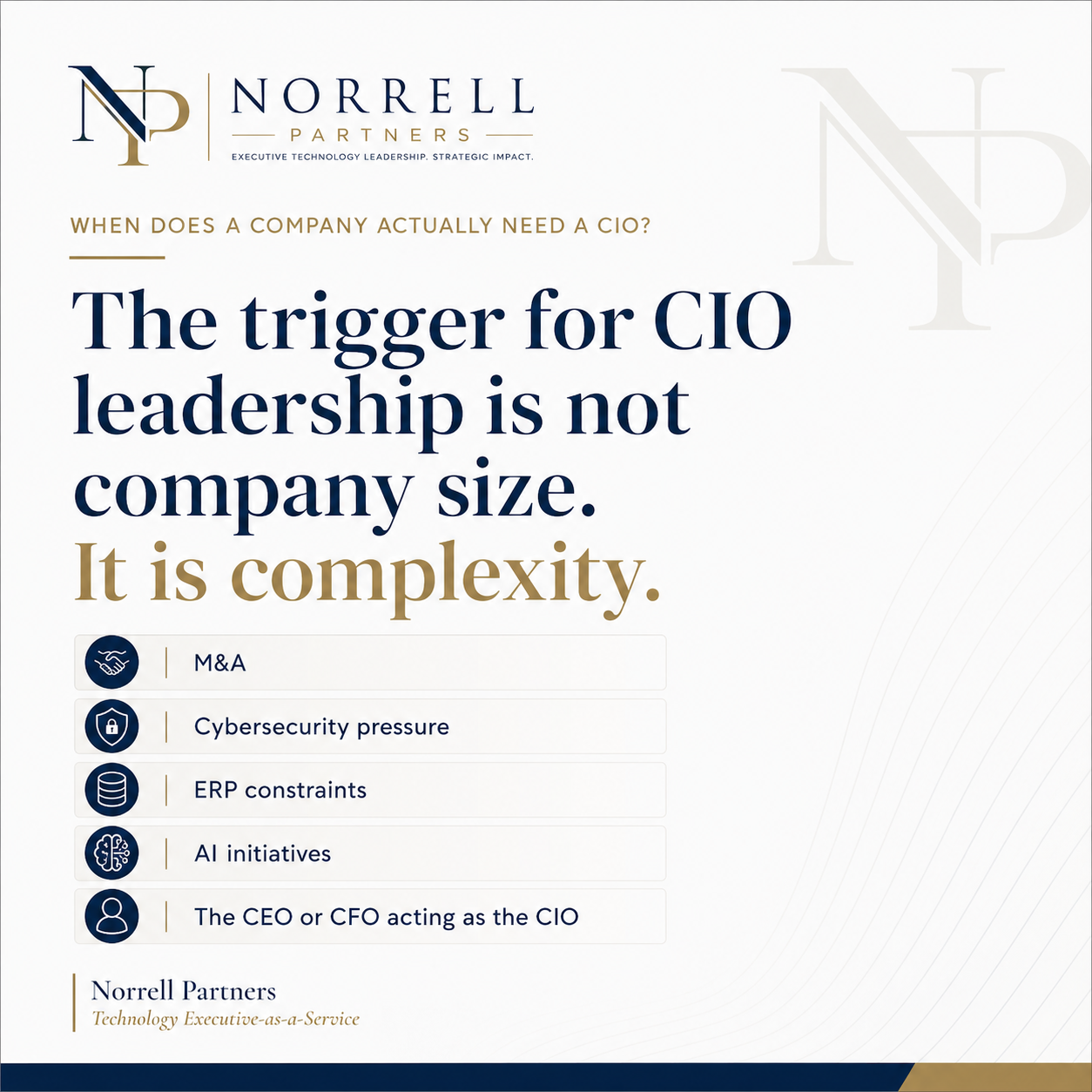
Company size is an imperfect measure
It is tempting to define the need for a CIO by revenue or headcount. Companies ask whether they need to reach $50 million in revenue, 250 employees or some other milestone before executive technology leadership makes sense.
There is no universal answer. Two companies of identical size can have completely different technology requirements. One may operate from a single location with a simple collection of SaaS applications. Another may have multiple locations, regulated customers, international operations, acquisitions, sensitive data, complex integrations and significant cybersecurity requirements.
Complexity creates the need for leadership
Several conditions tend to accelerate that need.
You are acquiring companies
M&A introduces different applications, networks, identity platforms, cybersecurity controls, vendors, infrastructure, data standards and technology teams. Someone has to decide what gets retained, integrated, replaced or retired.
Cybersecurity is becoming an executive issue
Customers send more detailed security questionnaires. Insurers increase requirements. Contracts add cyber obligations. Boards and investors want visibility. Security becomes enterprise governance rather than simply an IT responsibility.
Technology spending keeps increasing
SaaS, security products, consulting, cloud costs and licensing expand. The CFO can see spending rise but may not be able to answer whether the organization is investing in the right things.
Your ERP has become a business constraint
Reporting requires manual work, integrations are fragile or leadership knows the core platform needs to be replaced. That decision affects finance, operations, controls, data and how the company works.
AI projects are appearing throughout the organization
Departments want different tools, employees use public AI services and vendors add AI features. The challenge becomes a strategy question involving data, security, governance, workflows, applications and ROI.
Another strong signal: executive technology overload
Technology questions that used to stay within IT begin escalating. The CFO gets involved in vendor negotiations. The CEO is pulled into cybersecurity decisions. Leadership referees disputes between providers. Executives approve architecture choices they do not really want to own.
The problem is not necessarily a weak IT team. Often the team is very capable at operating the existing environment. What is missing is the layer of leadership responsible for deciding where the environment should go next.
IT operations and technology leadership are different disciplines
Operational IT asks: Is everything working?
Executive technology leadership asks: Are we building the right technology environment for where this company is going?
A capable IT Director or MSP may be excellent at support, infrastructure, administration, security operations, application management and project execution. CIO-level leadership owns strategy, investment priorities, enterprise architecture, risk, M&A, major systems, organizational capability, vendor strategy, AI governance and executive communication.
What should a strong Fractional CIO actually do?
- Establish priorities: decide which initiatives matter now, which can wait and which should stop.
- Evaluate risk: translate technology and cybersecurity exposure into business decisions.
- Challenge vendors: make sure MSPs, software providers and consultants deliver the right outcomes at the right cost.
- Create a roadmap: connect near-term projects to a coherent 12–36 month strategy.
- Align investment: ensure spending supports growth, efficiency, risk reduction and enterprise value.
- Drive execution: create accountability and governance so the roadmap actually gets implemented.
Complexity is the threshold
The trigger for CIO leadership is not a specific revenue number. It is not an employee count. It is the point where the consequences of technology decisions become significant enough that those decisions require executive judgment.
If these issues are already affecting your business, learn how Norrell Partners Fractional CIO leadership can provide the executive ownership, independent judgment and accountability to move from decision to execution.
Frequently Asked Questions
Questions executives commonly ask
At what company size should you hire a Fractional CIO?
There is no universal employee or revenue threshold. Complexity is generally a better indicator. Companies facing rapid growth, acquisitions, cybersecurity requirements, major system changes, AI adoption or increasing technology investment may need CIO-level leadership earlier than their size would suggest.
Is a Fractional CIO only for small companies?
No. Fractional CIOs can also support mid-market organizations, portfolio companies and larger businesses during leadership transitions, acquisitions, transformations or periods when specialized executive technology experience is required.
What is the difference between a Fractional CIO and a technology consultant?
A technology consultant usually advises on a specific issue or project. A Fractional CIO operates as part of executive leadership, helping establish priorities, make investment decisions, govern risk, oversee vendors and ensure technology strategy supports the business.
How often does a Fractional CIO work with a company?
The engagement model varies. Some organizations need several hours or days each month, while others require more significant involvement during acquisitions, ERP implementations, cybersecurity programs or major transformations.
When should a company hire a full-time CIO instead?
A full-time CIO becomes appropriate when the scale, complexity and pace of technology decision-making require continuous executive leadership. A Fractional CIO can often help determine when the organization has reached that stage.