
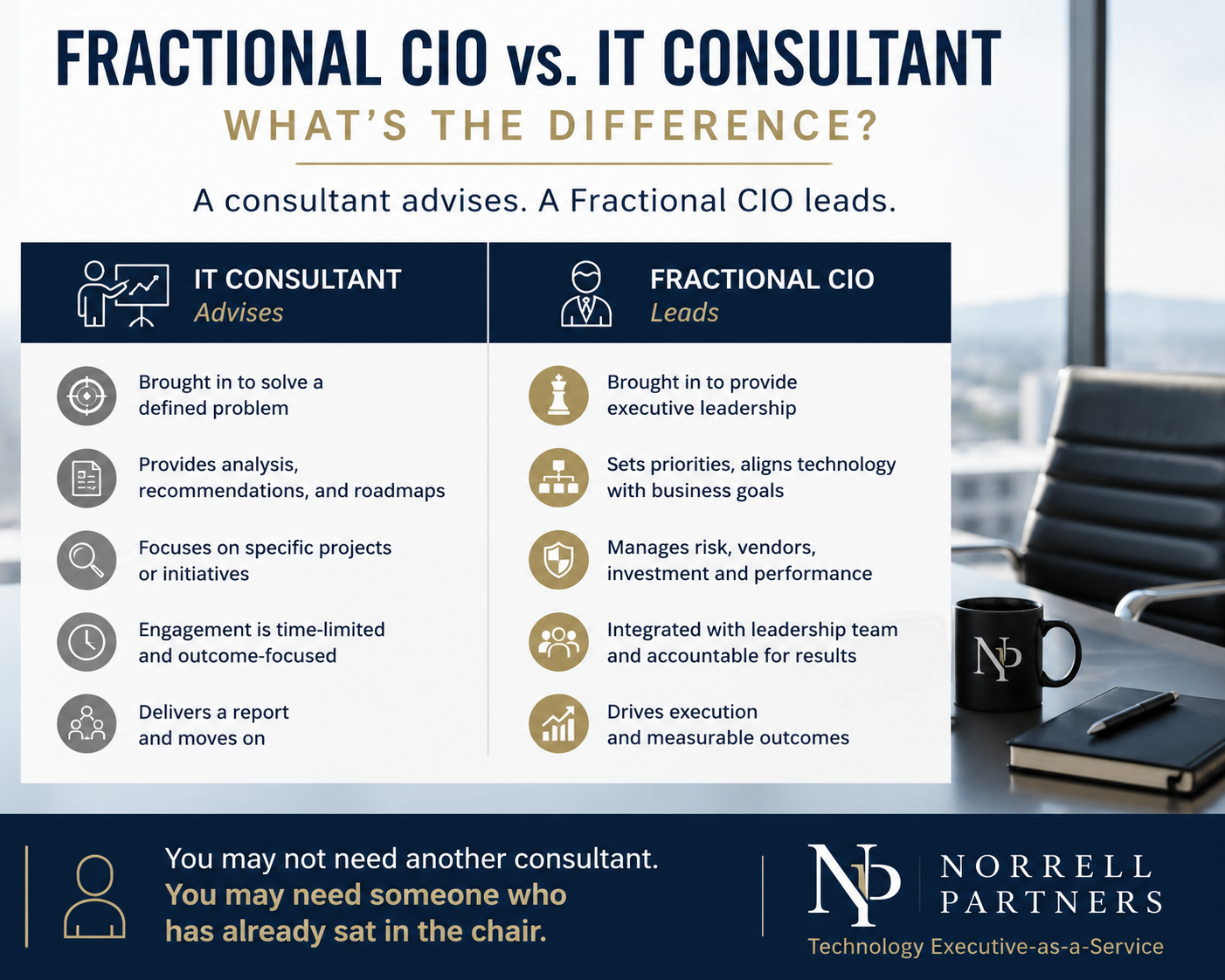
When the issue is bigger than a project
Traditional IT consulting can be extremely valuable. Consultants are often brought in because a company has a defined problem that requires specialized expertise: evaluate an ERP, review cybersecurity, assess infrastructure, recommend a cloud strategy, analyze spending, develop a roadmap or help select a vendor.
But many companies eventually reach a point where the problem is no longer a lack of advice. The ERP needs attention. Cybersecurity requirements are increasing. AI initiatives are appearing. An acquisition may be coming. Technology spending is growing. Departments are buying their own software. The MSP has recommendations. Finance and operations have competing priorities.
Those issues interact. At that point, bringing in another specialist to analyze one piece may not solve the underlying problem. The organization may not have a consulting problem. It may have a leadership problem.
What an IT consultant typically does
Consultants are generally engaged around a scope. There is a defined problem, a project and usually a deliverable. The result may be an assessment, recommendation, architecture, vendor selection, security review, transformation plan or roadmap.
That work can be exactly what the company needs. But once the assessment is complete, an important question remains: Who owns what happens next?
Someone still has to decide which recommendations matter most, reconcile competing priorities, get executive agreement, challenge vendors, determine what the company can afford, decide what risk is acceptable and ensure the work actually gets done. Those responsibilities belong to leadership.
A Fractional CIO operates differently
A strong Fractional CIO should function as part of the executive leadership structure rather than as an outside advisor who periodically produces recommendations.
Set priorities
Determine what matters now, what comes later and what should not be done at all.
Challenge vendors
Represent the company's interests when evaluating recommendations, contracts, architecture and investment.
Evaluate investment
Decide which initiatives support growth, efficiency, risk reduction or enterprise value.
Manage risk
Translate cybersecurity, continuity, data, vendor and infrastructure risks into business decisions.
Align technology
Make the technology roadmap a consequence of business strategy rather than a separate technical plan.
Drive execution
Create owners, governance, budgets, vendor accountability and visibility so decisions become outcomes.
Advice and accountability are different
Consider an ERP replacement. A consultant may conduct the evaluation and recommend three platforms. The business still needs someone to decide which system best supports the operating model, how much change the organization can absorb, what integrations and data work are required, what the company should spend, how the project should be governed and how executive disagreements will be resolved.
Those are not simply technology questions. They involve finance, operations, people, risk and strategy. That is why executive technology leadership matters.
Consultants and Fractional CIOs can work together
This is not an argument against consultants. Good CIOs regularly use specialists: cybersecurity firms, ERP implementers, cloud architects, penetration testers, data consultants, AI specialists, network engineers and diligence experts.
The same distinction applies to managed service providers. A strong MSP can run support, infrastructure, cloud services, endpoint management, networking, security operations, backup and monitoring. But the business still needs executive ownership of strategy, investment priorities, acceptable risk, M&A, enterprise architecture and board reporting.
Do you need expertise or ownership?
If you have a clearly defined problem and need specialized expertise, you may need a consultant.
If you need someone to evaluate the entire technology environment, establish priorities, make tradeoffs, coordinate vendors, advise executives and remain accountable for execution, you probably need leadership.
Executive technology decisions often involve incomplete information and imperfect tradeoffs. That requires judgment — and judgment is difficult to outsource to a report.
If these issues are already affecting your business, learn how Norrell Partners Fractional CIO leadership can provide the executive ownership, independent judgment and accountability to move from decision to execution.
Frequently Asked Questions
Questions executives commonly ask
What is the difference between a Fractional CIO and an IT consultant?
An IT consultant is usually brought in to solve a defined technology problem or provide specialized expertise. A Fractional CIO provides ongoing executive technology leadership, including strategy, prioritization, investment decisions, risk governance, vendor oversight and accountability for execution.
Does a Fractional CIO implement technology?
A Fractional CIO may lead or oversee implementation, but the role is typically not to perform every technical task directly. Specialists, internal teams and vendors may execute the work while the CIO provides direction, governance and accountability.
Can a company use both a Fractional CIO and IT consultants?
Yes. In many cases, this is the ideal structure. The Fractional CIO establishes strategy and priorities while specialized consultants or technology providers handle specific technical initiatives.
Is an MSP the same as a Fractional CIO?
No. An MSP generally delivers operational technology services such as support, infrastructure management and monitoring. A Fractional CIO provides executive leadership around strategy, investment, risk, governance and business alignment.
How do I know whether I need a consultant or a Fractional CIO?
If the issue is clearly defined and project-specific, a consultant may be appropriate. If multiple technology issues are competing for attention and no executive owns the overall strategy, priorities and outcomes, CIO-level leadership may be the better fit.