
The problem is usually not that IT is failing
A company can have a capable IT team and still have a technology leadership gap. The help desk may be responsive. Systems may be reliable. The network may be stable. The MSP may be doing exactly what it was hired to do.
Yet important questions remain unanswered: Are we investing in the right technology? Can our systems support the next phase of growth? Are we carrying risks leadership does not fully understand? Should we replace a major platform? Are our vendors performing? What should technology cost us? How should AI fit into the business?
Those are not operational IT questions. They are executive management questions.
The CEO or CFO becomes the accidental CIO
Technology decisions that once stayed inside IT start moving upward. A vendor dispute reaches the CFO. A cybersecurity issue reaches the CEO. The board asks for an AI strategy. The MSP wants to know what the future architecture should look like. An ERP implementation requires decisions spanning finance, operations, HR and technology.
Eventually someone on the executive team realizes: I have somehow become the CIO.
Functionally, the CEO or CFO is being asked to make executive technology decisions because nobody else is accountable for connecting technology to business strategy.
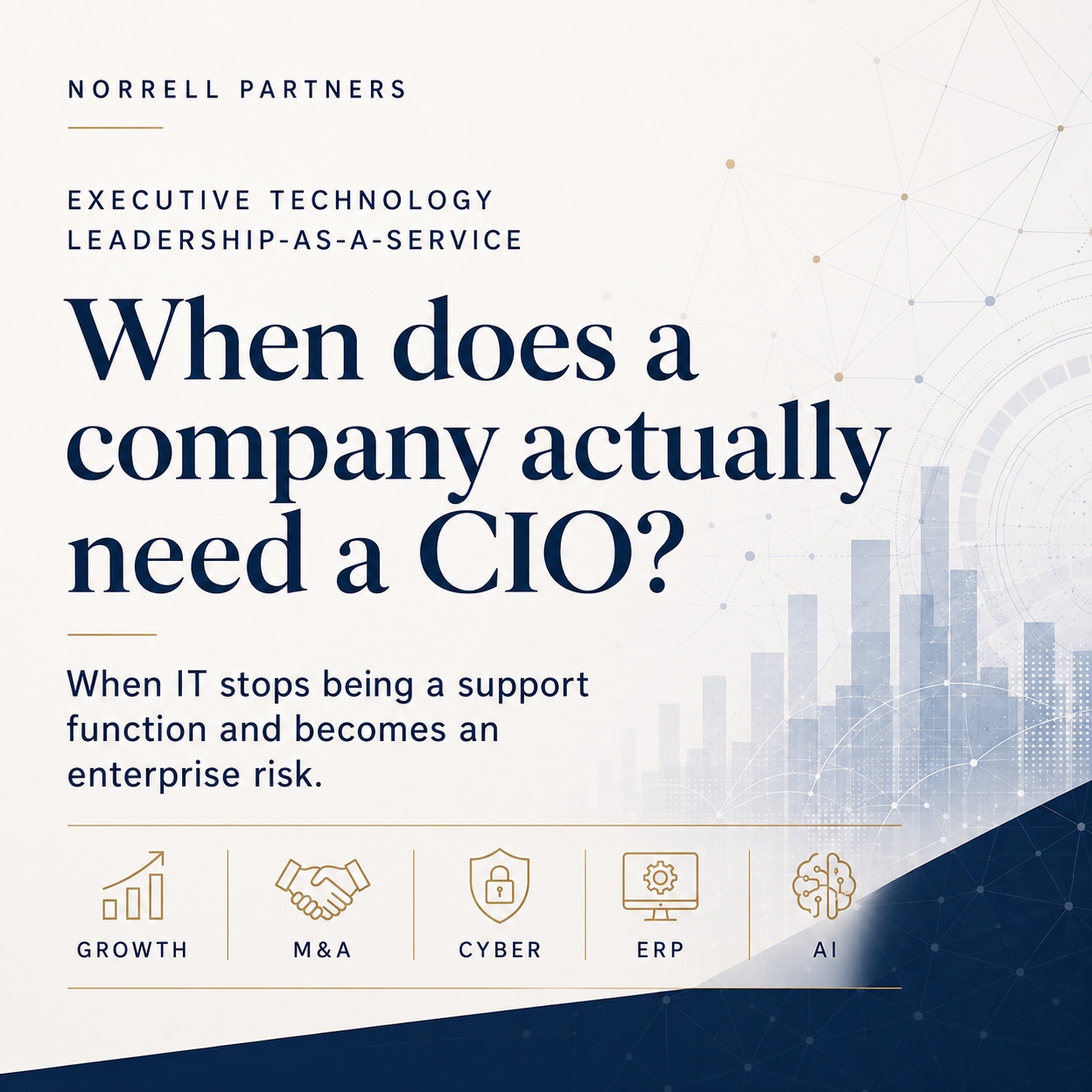
Five common technology inflection points
1. Growth
More employees, locations, customers and systems change the question from “Does it work?” to “Can this scale?”
2. M&A
Acquisitions introduce different applications, identities, controls, vendors, data and operating models that require coordinated integration decisions.
3. Cybersecurity
Customer requirements, cyber insurance, contracts, boards and investors turn security from a technical issue into a governance issue.
4. Major systems
ERP, CRM and other core platform changes affect business processes, reporting, controls, data and organizational adoption — not just IT.
5. AI
AI quickly becomes a strategy question involving data, security, governance, workflows, applications, people and measurable business value.
Technology spending is another warning sign
Technology spending often rises while accountability stays fragmented. Departments own applications. The MSP owns part of the infrastructure. Security vendors own pieces of cyber. Finance approves contracts. Operations runs implementations.
The organization may know what each component costs but still be unable to answer the more important question: Are we spending the right amount on the right things?
That is how companies accumulate duplicate applications, overlapping vendors, unnecessary licenses, fragile integrations, aging platforms, security gaps, manual processes and technology debt.
A Fractional CIO fills the leadership gap
Crossing the inflection point does not automatically mean the company needs a full-time CIO. For many mid-market organizations there is an intermediate stage: the business is too complex to operate without executive technology leadership, but it may not require another full-time C-suite position.
A Fractional CIO can establish technology strategy, investment priorities, a 12–36 month roadmap, cybersecurity governance, vendor accountability, major system decision-making, M&A planning, AI strategy and board-level reporting while working alongside the existing IT team and MSP.
The test is surprisingly simple
If major technology decisions keep landing on the CEO's or CFO's desk, ask:
Not who fixes technology. Not who administers it. Not who sells it. Who owns the decisions? If the answer is unclear, the organization may already have crossed the inflection point.
If these issues are already affecting your business, learn how Norrell Partners Fractional CIO leadership can provide the executive ownership, independent judgment and accountability to move from decision to execution.
Frequently Asked Questions
Questions executives commonly ask
What are the signs that a company needs a CIO?
Common signs include rapid growth, rising technology spending, acquisitions, major system replacements, cybersecurity pressure, increasing vendor complexity, AI adoption and technology decisions regularly escalating to the CEO or CFO.
Can an MSP provide CIO-level leadership?
An MSP can be an important technology operating partner, but its primary responsibility is usually delivering contracted services. CIO leadership is broader and includes business alignment, investment priorities, technology strategy, governance, risk and executive accountability.
Does a company need a full-time CIO?
Not necessarily. Many organizations reach a stage where they need CIO-level expertise but do not yet require a full-time executive. Fractional, interim or advisory CIO models can provide that leadership.
What does a Fractional CIO actually own?
Depending on the engagement, a Fractional CIO may own technology strategy, roadmap development, budgeting, major system decisions, cybersecurity governance, M&A planning, vendor oversight, AI strategy and executive or board reporting.