
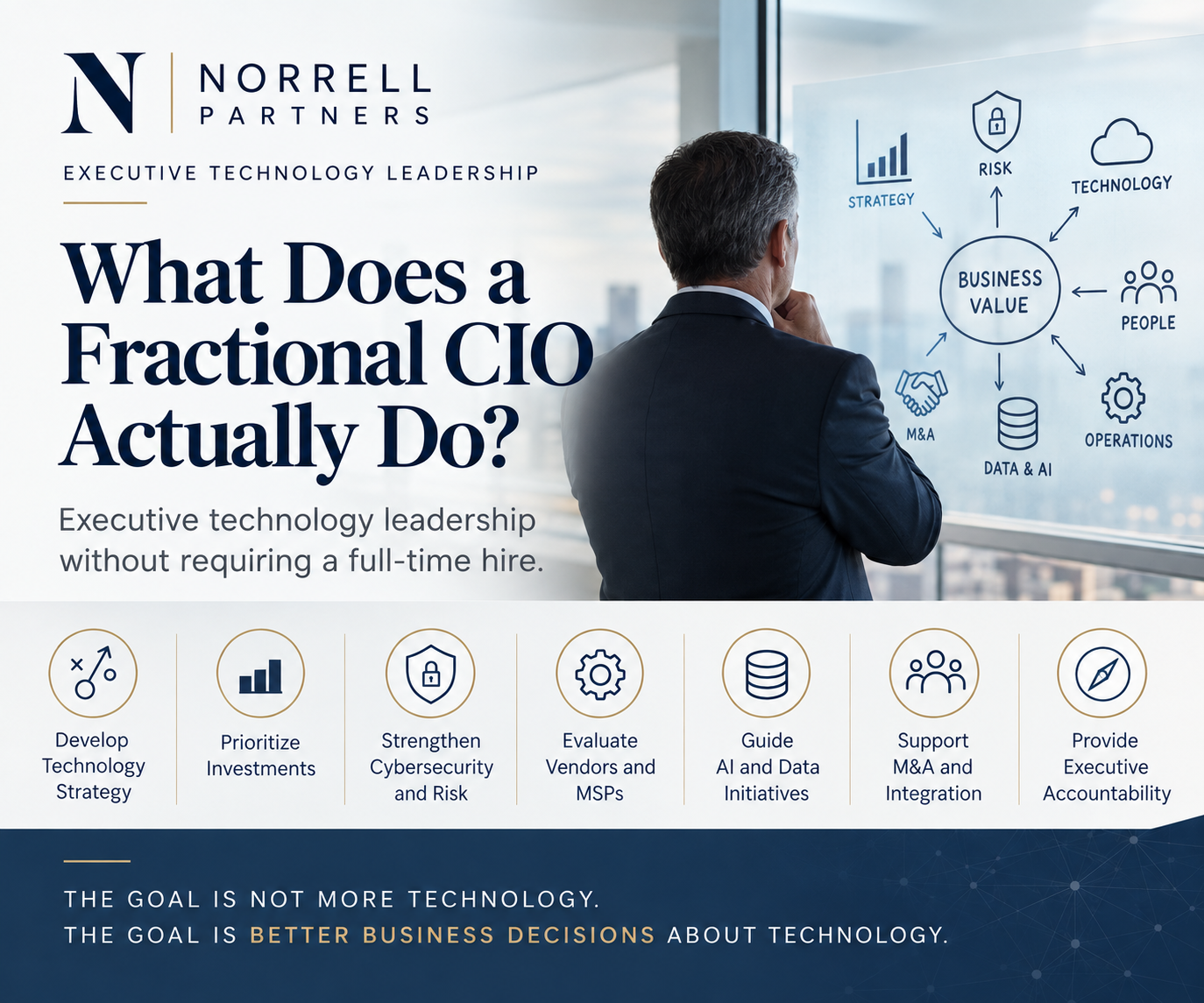
Technology activity is not the same as technology leadership
Most organizations do not have a shortage of technology activity. Projects are underway. Vendors are making recommendations. Security tools are being renewed. Business units want new systems. AI pilots are appearing. Infrastructure is being modernized. Employees are asking for better tools.
All of that can create the impression that technology is being actively managed.
But activity does not answer the most important executive question: Are we making the right technology decisions for the business?
That is where CIO-level leadership becomes different from IT management. The CIO is not there to maximize the amount of technology in the organization. The CIO is there to help leadership decide what technology should accomplish, where investment is justified, what risks matter and what the business should deliberately choose not to do.
Start with the business, not the technology stack
A strong technology strategy begins with the company’s objectives: growth, margin improvement, customer experience, geographic expansion, acquisition integration, risk reduction, operating leverage or a future transaction.
Only then should the conversation move to systems, platforms and vendors.
This changes the questions leadership asks. Instead of “Should we replace the ERP?” the question becomes “What business constraint are we trying to remove, and is the ERP actually the cause?” Instead of “Should we buy an AI platform?” the question becomes “Which processes have enough economic value to justify redesign, automation or AI?”
That distinction matters because technology is rarely the objective. It is an enabler, a constraint, a source of risk or an investment that should produce a measurable business result.
Good technology leadership creates tradeoffs
One of the most important jobs of a CIO is deciding what not to do.
Every organization has limited capital, management attention and execution capacity. If ten initiatives are labeled “strategic,” the company usually does not have ten priorities. It has a prioritization problem.
CIO-level leadership creates a portfolio view. Projects can be compared against business value, urgency, risk, cost, dependencies, technical debt and organizational readiness.
- Some investments should accelerate because they unlock growth or reduce material risk.
- Some should be sequenced behind more foundational work.
- Some should be simplified rather than expanded.
- Some vendor proposals should be challenged.
- Some legacy systems should remain in place because replacing them would not create enough value.
- Some projects should stop.
Saying no is not resistance to technology. It is part of responsible technology leadership.
Technology spending should have an investment thesis
A technology budget is often treated as a collection of contracts, headcount, licenses, projects and infrastructure costs. A CIO should help leadership see it differently: as a portfolio of investments supporting business capabilities and managing risk.
For each material initiative, the organization should be able to answer basic questions:
- What business outcome are we expecting?
- What problem is this solving?
- What happens if we do nothing?
- What other investments compete for the same resources?
- Who owns the outcome?
- How will we know whether it worked?
Not every technology investment produces a direct financial return. Cybersecurity, resilience and regulatory requirements may be about reducing the probability or impact of loss. But even those decisions should be explicit rather than driven by fear, vendor pressure or habit.
Independent judgment matters
Technology decisions are frequently influenced by parties with legitimate but different incentives. Software companies want to sell platforms. MSPs want to provide services. Consultants may be scoped around particular projects. Internal teams may prefer technologies they already know. Business units may optimize for their own needs.
None of those perspectives is inherently wrong.
But someone needs to represent the interests of the enterprise as a whole.
That is why independent executive judgment has value. A CIO should be able to ask whether the proposed architecture is appropriate, whether a vendor is solving the right problem, whether the organization is buying more capability than it can use, and whether the expected business outcome justifies the investment.
The answer should be based on what is right for the company — not on what someone has to sell.
Risk is also a business decision
Cybersecurity, continuity, privacy, technical debt and aging systems are often discussed as technical deficiencies. At the executive level, they are business risks.
The CIO’s responsibility is not to eliminate every risk. That is neither practical nor economically rational. The responsibility is to make risk visible enough that leadership can make informed decisions about it.
What is the potential business impact? What would mitigation cost? What risk remains afterward? Is management consciously accepting that exposure, or simply unaware of it?
When technology risk is translated into business language, executives can allocate capital and attention appropriately.
AI makes decision discipline even more important
AI is a useful example because the technology is advancing faster than most organizations can absorb it.
The question is not whether the company should “do AI.” Most organizations already are, formally or informally.
The executive questions are more useful: Where can AI create measurable value? Which data can be used safely? What governance is required? Which processes should be redesigned before automation? Where is experimentation appropriate? Which use cases create unacceptable legal, privacy, security or reputational risk?
A company can spend heavily on AI and still create very little value. Leadership is what connects the technology to an operating model and a business outcome.
Better decisions require ownership
Decision quality improves when accountability is clear.
If nobody owns the technology portfolio at the executive level, important decisions tend to fragment. Finance negotiates cost. IT evaluates technical fit. Security focuses on risk. Operations focuses on workflow. Vendors provide recommendations. Individual executives sponsor projects.
Each perspective may be valid, but the organization still needs someone to connect them.
CIO-level ownership creates a single point of executive accountability for priorities, architecture, investment, risk and execution. That does not mean the CIO makes every decision alone. It means somebody is responsible for ensuring the decisions fit together.
What better technology decision-making looks like
When technology leadership is working, the CEO and leadership team should have a much clearer view of the environment.
- There is a small number of agreed technology priorities tied to business objectives.
- Major technology spending has a clear rationale.
- Risks are visible and discussed in business terms.
- Vendors are managed against expectations rather than simply renewed.
- Projects have owners, outcomes and decision points.
- Architecture choices support where the business is going.
- AI and cybersecurity are governed as enterprise issues.
- Leadership understands what is deliberately not being funded.
The result is not necessarily a larger technology organization. In many cases, it is a simpler one.
The real measure of Fractional CIO value
A Fractional CIO should not be judged by the number of projects started, meetings attended or products introduced.
The better measure is whether the organization makes technology decisions with greater clarity and confidence.
That is the difference between managing technology activity and exercising executive technology leadership.
If these issues are already affecting your business, learn how Norrell Partners Fractional CIO leadership can provide the executive ownership, independent judgment and accountability to move from decision to execution.
Frequently Asked Questions
Questions executives commonly ask
What is the primary goal of a Fractional CIO?
The primary goal is to improve executive decision-making about technology by connecting priorities, investments and risks to business objectives and establishing clear ownership and accountability.
Should a CIO always recommend more technology investment?
No. Strong CIO leadership may recommend investing, consolidating, simplifying, delaying or stopping initiatives depending on business value, risk, cost and organizational capacity.
How does CIO leadership improve technology spending?
CIO leadership creates a portfolio view of technology investments, evaluates tradeoffs, challenges vendor proposals, aligns spending to business priorities and makes ownership and expected outcomes visible.
Why is independent technology judgment important?
Independent judgment helps leadership separate what the business actually needs from what vendors, platforms or internal stakeholders may prefer to sell, build or prioritize.