
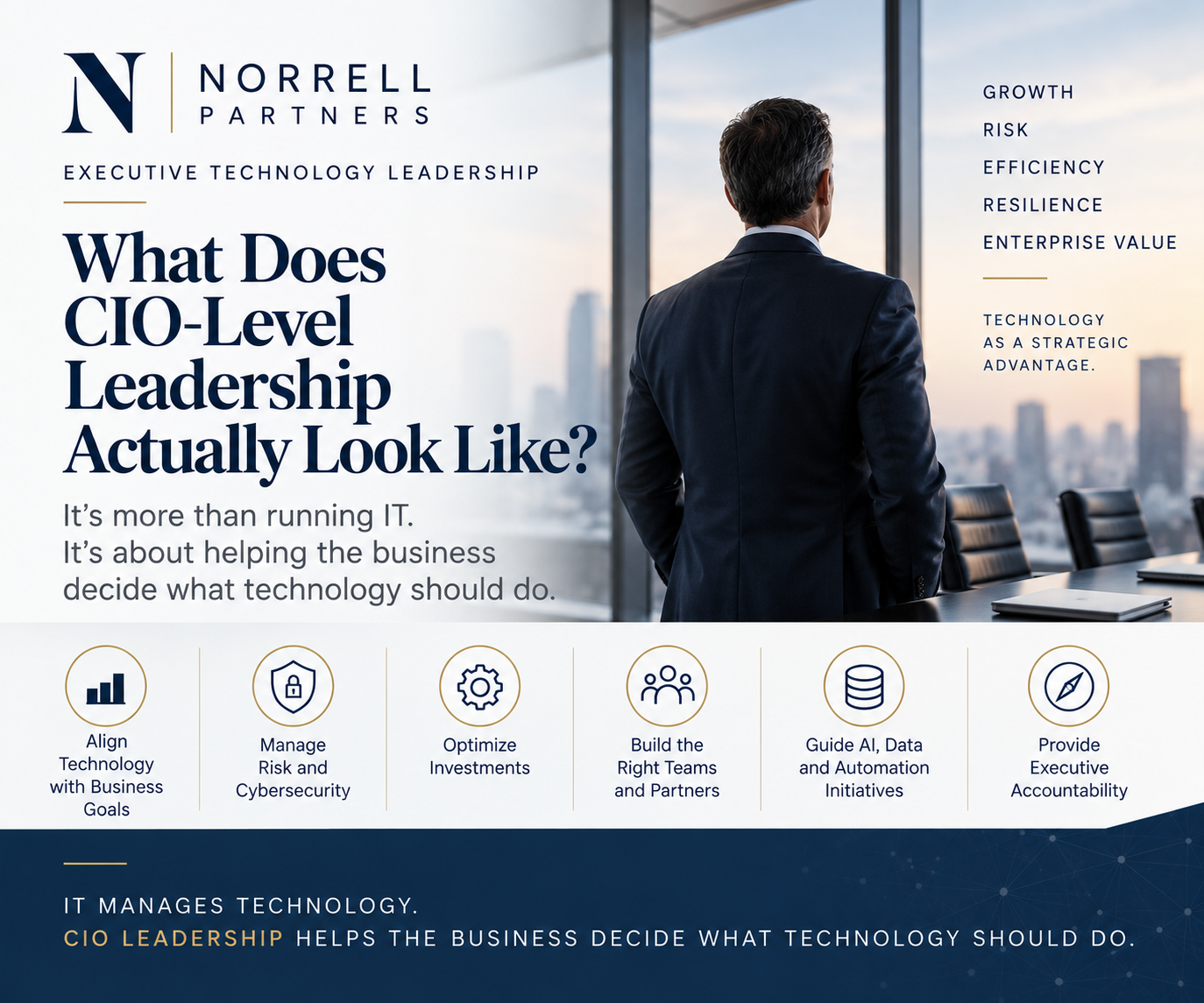
Most companies know what IT management looks like
Tickets get resolved. Systems stay online. Vendors are managed. Projects get completed. Employees receive support. Infrastructure is maintained.
Those things matter. A business cannot operate reliably without strong technology operations.
But none of them, by themselves, answer the questions that belong at the executive table.
Where should the company invest? Which risks should leadership accept? How should technology support growth? Is the organization structured correctly? What should be outsourced? How should AI and data change the operating model? What technology capabilities will matter in an acquisition, integration or eventual exit?
That is the difference between managing IT and providing CIO-level leadership.
CIO leadership starts with business alignment
The CIO should understand the company’s strategy well enough to translate it into technology priorities.
If the business is growing through acquisition, technology needs to support integration, scalability and repeatability. If margin expansion is a priority, automation, process redesign and vendor economics may matter more. If the company is preparing for a transaction, risk, data quality, architecture and operational durability may become critical.
The technology roadmap should therefore look different depending on what the business is trying to accomplish.
This is why strong CIOs spend significant time with the CEO, CFO, operating leaders and board rather than only with the technology team.
It creates a coherent investment portfolio
Technology spending can easily become fragmented. Individual departments buy software. Infrastructure contracts renew automatically. Security tools accumulate. Projects receive funding independently. Legacy applications remain because nobody owns the decision to replace them.
CIO-level leadership brings those investments together.
The executive view asks whether the portfolio is balanced, whether spending supports the company’s priorities, whether platforms overlap, whether vendors are delivering value and whether the organization has enough capacity to execute what has been funded.
The goal is not simply cost reduction. In some cases, the right decision is to spend more. The discipline is making sure the spending has a business reason.
It treats cybersecurity as enterprise risk
Cybersecurity is a technical discipline, but the most important decisions are business decisions.
How much risk is the company carrying? What would a meaningful incident do to operations, customers, reputation or enterprise value? Which controls materially reduce exposure? What should the board know? Where is the organization consciously accepting risk?
A CIO working with security leadership should be able to translate technical findings into executive consequences and investment choices.
The objective is not to turn the board into security engineers. It is to give leadership enough clarity to govern the risk.
It builds the right technology organization
As companies grow, they often accumulate a mix of internal staff, MSPs, consultants, software vendors and business-owned systems.
CIO-level leadership determines how those pieces should fit together.
Which capabilities are strategic enough to own internally? Which are better delivered by a specialist? Is the MSP being asked to make decisions that should belong to management? Does the internal team have clear accountability? Are roles designed for the company the business is becoming rather than the company it was three years ago?
Organization design is part of technology strategy because execution depends on having the right ownership and capabilities.
It makes architecture a business decision
Architecture can sound highly technical, but poor architecture eventually appears in business terms: higher cost, slower change, integration difficulty, unreliable data, security exposure and dependence on a small number of people or vendors.
A CIO should make sure major technology decisions fit together over time.
That does not mean pursuing architectural purity. Mid-market companies usually need pragmatism more than perfection. The question is whether systems and platforms create enough flexibility, durability and interoperability for where the business is going.
It brings discipline to AI and data
AI is increasingly part of the CIO agenda because successful adoption requires more than selecting a model or purchasing licenses.
The organization needs usable data, secure access, governance, workflow integration, change management and a clear understanding of where AI can create economic value.
CIO-level leadership connects those pieces. It prevents AI from becoming a collection of unrelated experiments and instead treats it as an enterprise capability that needs ownership, standards and measurable outcomes.
The same applies to data. Reporting problems are often symptoms of fragmented systems, inconsistent definitions or unclear ownership. A CIO helps connect data strategy to the broader operating environment.
It leads major transformation without losing the business
ERP replacements, CRM programs, cloud migrations, cybersecurity transformations and post-acquisition integrations are not purely technology projects.
They change processes, responsibilities, controls and the way people work.
CIO leadership keeps the business outcome in view while managing the complexity of execution. That includes sequencing, governance, vendor accountability, change management, budget visibility and escalation when decisions are required.
The CIO should not allow the project plan to become more important than the reason the company started the project.
It creates executive visibility
Boards and executive teams need technology reporting that helps them govern the business.
That usually means fewer technical metrics and more clarity around priorities, risk, investment, progress and decisions.
What are the top technology initiatives? Are they on track? What changed? What risks deserve attention? Where does management need a decision? What outcomes have been created? What is coming next?
Good executive reporting creates confidence because leadership knows both what is happening and where accountability sits.
It also means saying no
A senior technology executive should not be measured by enthusiasm for every new technology.
Sometimes the right answer is not to replace a platform. Not to pursue a vendor recommendation. Not to start an AI initiative yet. Not to hire another person. Not to expand a project that has lost its business case.
The CIO is responsible for judgment, not volume.
What leadership should feel like from the CEO's perspective
The most useful test may be what changes for the CEO, CFO and leadership team.
Before CIO-level leadership, technology decisions may feel fragmented, technical or reactive. The CEO gets pulled into vendor disputes. Finance sees costs without a coherent investment story. The board hears about cyber risk without enough context. Business leaders sponsor systems independently. Nobody has a complete view.
With strong CIO leadership, those issues become more structured. The company has priorities. Major decisions have owners. Risks are explicit. Vendors are challenged. Technology spending is connected to outcomes. Leadership knows where the organization is going.
That is what executive technology leadership should provide.
The role is ultimately about enterprise value
Technology affects nearly every part of the modern business: revenue, margin, risk, customer experience, employee productivity, scalability, M&A, resilience and the ability to change.
That is why the CIO role has moved beyond keeping systems running.
At the executive level, technology is a portfolio of capabilities and risks that should be managed in the context of enterprise value.
A company may not need a full-time CIO to reach that point. But once technology has become material to the business, someone needs to provide CIO-level leadership.
If these issues are already affecting your business, learn how Norrell Partners Fractional CIO leadership can provide the executive ownership, independent judgment and accountability to move from decision to execution.
Frequently Asked Questions
Questions executives commonly ask
How is CIO-level leadership different from IT management?
IT management focuses primarily on operating technology effectively. CIO-level leadership connects technology to business strategy, investment, risk, organizational capability and enterprise outcomes.
What does a CIO focus on at the executive level?
A CIO focuses on business alignment, investment priorities, enterprise architecture, cybersecurity and technology risk, organizational capability, major transformation, data and AI, M&A and executive accountability.
Does a smaller company need CIO-level leadership?
A smaller company may need CIO-level leadership when technology has become material to growth, risk, investment or enterprise value even if the company does not yet need a full-time CIO.
What should leadership expect from a CIO?
Leadership should expect clear priorities, business-oriented technology decisions, risk visibility, disciplined investment, accountable execution and an executive who can translate between the business and technical teams.