
A Fractional CIO is not there to "help with IT"
The role is broader than that.
A Fractional CIO is there to lead technology at the executive level — looking across the business, understanding where the organization is going and turning technology into a coherent set of priorities, decisions and actions.
That means answering questions that typically do not belong to the help desk, an MSP or a single department:
- What are our most important technology priorities?
- Where are we carrying unnecessary risk?
- Which systems are holding the business back?
- Are we spending money in the right places?
- Which vendors should we keep, challenge, replace or consolidate?
- What needs to be decided now, and what can wait?
- How should cybersecurity, AI, M&A, data and infrastructure fit into one strategy?
A strong Fractional CIO turns those questions into an operating model.
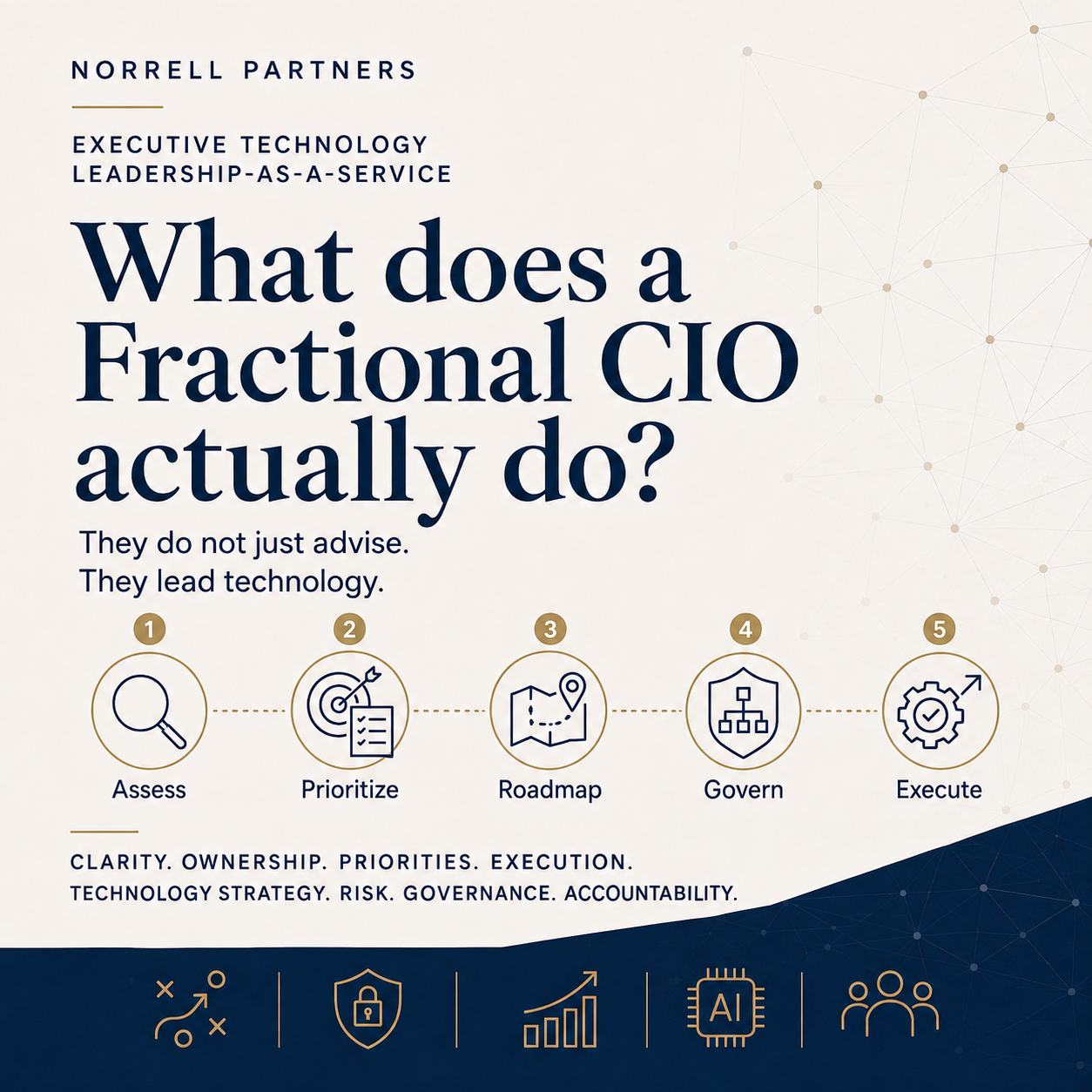
1. Assess the environment
The first job is to understand the current state — not just the technology itself, but how the business depends on it.
An assessment may include core systems, infrastructure, cybersecurity, vendors, budgets, projects, data, integrations, internal capabilities and the way technology decisions are currently made.
The goal is not to produce a long inventory for its own sake. It is to identify what matters: constraints, risk, unnecessary complexity, investment gaps and decisions leadership needs to make.
2. Prioritize what matters
Most companies do not suffer from a shortage of technology ideas. They suffer from too many competing priorities.
Finance wants better reporting. Operations wants automation. Security needs investment. The ERP needs work. AI initiatives are appearing. Vendors are proposing projects. Employees want better tools.
The CIO's role is to make tradeoffs.
Projects should be evaluated against business value, urgency, risk, cost, dependencies and organizational capacity. Some should accelerate. Some should wait. Some should stop.
3. Build the roadmap
Once priorities are clear, they need to become a practical roadmap.
A useful technology roadmap is more than a project list. It connects technology initiatives to business objectives and identifies sequencing, dependencies, investment requirements and accountability.
It should answer questions such as:
- What should happen in the next 90 days?
- What should the company accomplish over the next 12 months?
- Which decisions shape the next 24–36 months?
- What investments are required?
- What risks are being accepted or reduced?
The roadmap gives executives a way to understand where technology is going and why.
4. Establish governance
A roadmap without governance can quickly become another document that sits on a shelf.
Governance creates the mechanism for making decisions and maintaining momentum.
That may include executive steering meetings, budget reviews, project checkpoints, cybersecurity risk reporting, vendor scorecards, architecture standards, AI governance and clear ownership of major initiatives.
The purpose is not bureaucracy. It is clarity.
Who decides? Who owns the outcome? What gets escalated? How is risk communicated? How do executives know whether the plan is working?
5. Help drive execution
This is where Fractional CIO leadership should differ from a traditional advisory engagement.
The deliverable is not simply a recommendation.
The CIO works with the internal team, MSPs, consultants, software providers and executives to help turn decisions into outcomes. That can mean resolving roadblocks, challenging vendors, reviewing project performance, adjusting priorities and ensuring leadership has visibility when decisions are required.
The goal is not to perform every technical task personally. It is to create accountability around the work and help ensure the right things get done.
Translate technology into business language
A CIO also serves as the bridge between technical teams and executive leadership.
The CEO and board do not necessarily need to understand every technical detail. They do need to understand the business consequences of technology decisions.
What does this risk mean financially? What happens if the project is delayed? Why does this platform need to be replaced? What business capability does this investment create? What risk are we accepting if we do nothing?
Technology leadership turns those questions into decisions executives can make.
Work with the existing team, not around it
A strong Fractional CIO should make the existing technology organization more effective.
That may mean helping an IT Director gain executive alignment, giving an MSP clearer direction, bringing structure to vendor relationships, creating a decision framework for business leaders or adding experience around an ERP, acquisition, cybersecurity program or AI initiative.
The objective is not to create another layer of consulting. It is to give the organization a clear executive owner for technology.
The real deliverable
At the end of the day, the value of a Fractional CIO should not be measured by the number of meetings attended or PowerPoint decks produced.
The CEO, CFO and board should know where technology is going, what it costs, what risks matter, what decisions are coming and who is accountable for getting the work done.
That is what a Fractional CIO should actually do.
If these issues are already affecting your business, learn how Norrell Partners Fractional CIO leadership can provide the executive ownership, independent judgment and accountability to move from decision to execution.
Frequently Asked Questions
Questions executives commonly ask
What does a Fractional CIO do?
A Fractional CIO provides executive technology leadership on a part-time or advisory basis. Typical responsibilities include assessment, prioritization, roadmap development, governance, risk management, vendor oversight and leadership of execution.
Does a Fractional CIO manage the IT team?
The exact model varies. A Fractional CIO may directly lead the technology function or work alongside an existing IT Director, MSP or other operational leader while providing executive direction and accountability.
What should a Fractional CIO deliver in the first few months?
A strong engagement should create clarity around the current state, immediate risks, priorities, a practical roadmap, governance, ownership and the decisions leadership needs to make.
Does a Fractional CIO do technical implementation work?
The Fractional CIO may lead and oversee implementation, but internal teams and specialized vendors often perform the hands-on technical work. The CIO is accountable for direction, coordination and outcomes.
How is a Fractional CIO different from an IT consultant?
A consultant often advises on a defined problem. A Fractional CIO operates as an executive leader across the technology portfolio and remains involved in priorities, governance, decisions and execution.